

By Thea Tjepkema
We doubt if any other building of such dimensions in this country is so well
and perfectly lighted. Cincinnati Enquirer, May 15, 1878.
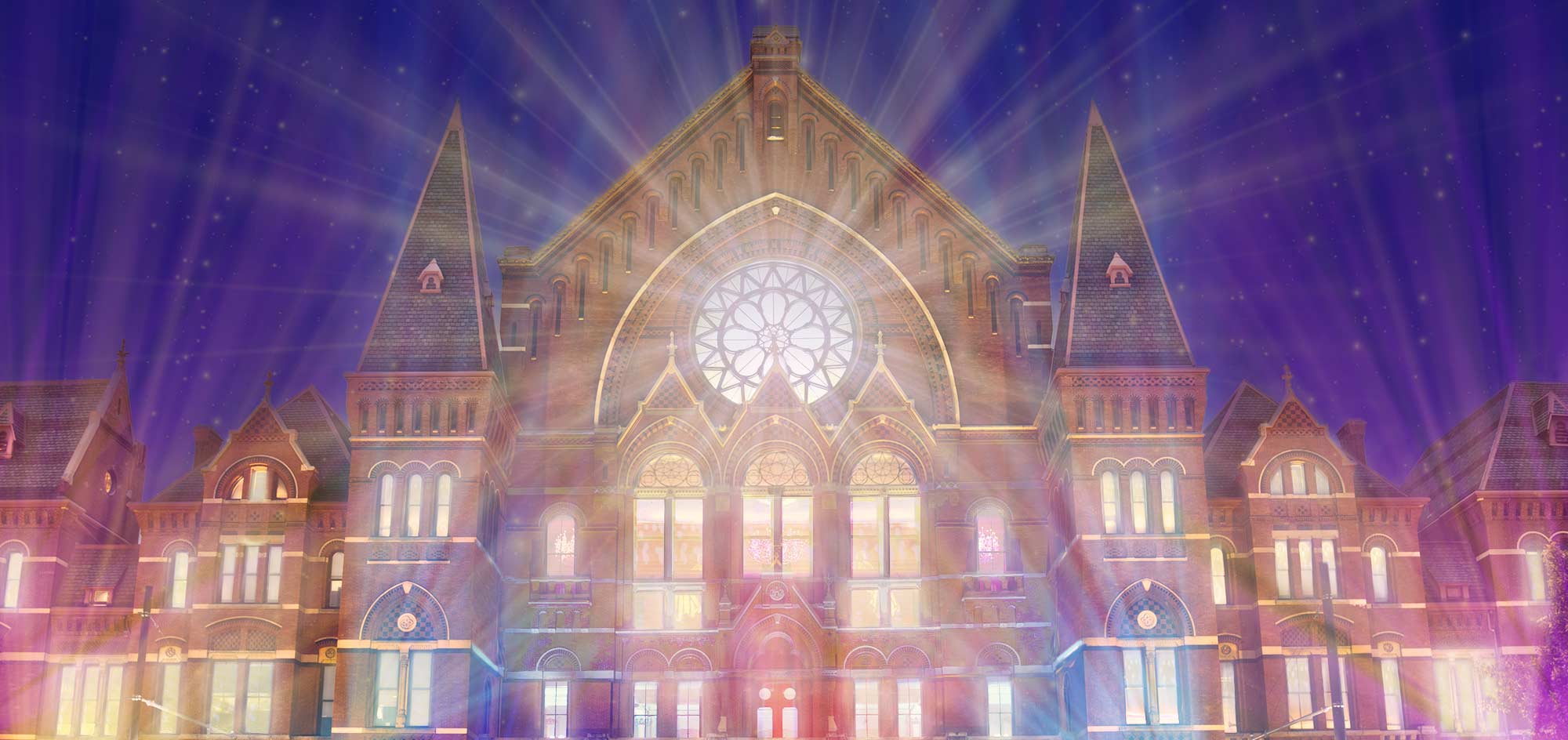
Let’s shed some light on the history of lighting in and on Music Hall and Cincinnati, from the city’s first gas light installation in 1843 to the slow acceptance of electricity and the incandescent light bulb, and to the city’s first festivals in lights. Music Hall could claim the city’s first Blink in the nineteenth century! This is the story of how Music Hall learned to shine.
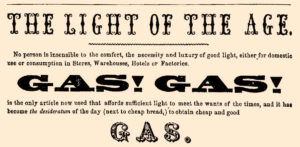
Williams’ City Directory, 1856, p. 92.
Opening in 1878, with its north and south halls completed in 1879, Music Hall has featured dazzling, brilliant, colorful, innovative, and spectacular lighting displays for Industrial Expositions, Fall Festivals, and many other events over its nearly 150 years. These enlightening stories range from Music Hall’s early gas jets and piping to generators in power rooms with miles of wires leading to thousands of temporary novelty lighting displays, to permanent electrical installation in 1895, to today’s new LEDs and the latest exterior state-of-the-art lights funded by the Friends of Music Hall in 2026. The evolution of Music Hall’s lighting is as fascinating as its celebrities in the limelight.
CINCINNATI’S FIRST GAS LIGHTS
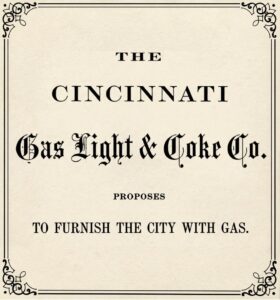
Terms, Rules, Regulations, 1860.
In 1843, the Cincinnati Gas, Light, and Coke Company (CGL&C Co.) opened a plant to produce distilled coal gas, and W.H. Harrison & Co. Drugstore became the first to turn on gas lights. The City Council voted to install 100 gas streetlamps, and demand for more grew. Music Hall opened amid gas streetlamps, which reached their apex by the turn of the century as electric lamps began their ascendancy. Today, about 1,200 gas streetlamps still operate across Cincinnati.
MUSIC HALL’S GAS LIGHTS
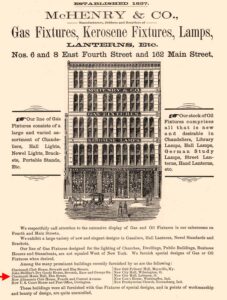
Kenny’s Cincinnati Illustrated, 1879, p. 179.
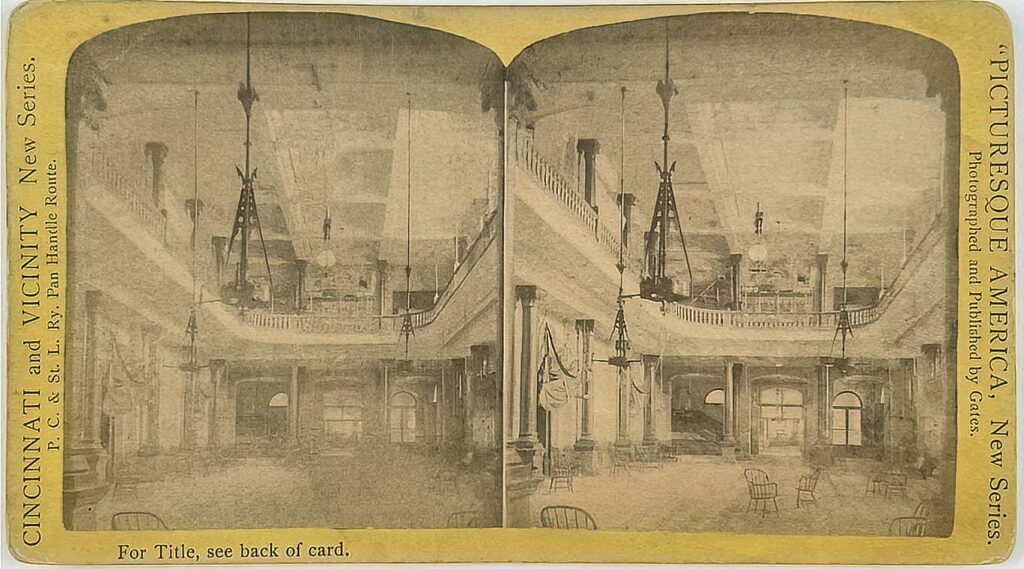
In April of 1878, the Enquirer reported that McHenry & Co. had won the contract for gas light fixtures at Music Hall, promising designs would be “all original and appropriate” with the “finest and most durable finish ever used,” and “the fixtures would be hung and lighted about the first of May.” The fixtures were installed in time for the opening of Music Hall on May 14, 1878, for the Third May Festival. Over 10,000 people gathered outside, awed by the magnificent building. The broad doors were “thrown open” for 6,000 ticketholders at 6:30 p.m. The concert began after sunset, while gas streetlamps illuminated the scene outside. The Enquirer described the hall as “brilliantly lighted by hundreds of gas jets from chandeliers and brackets, [which,] while not elaborate, yet are handsome.”
McHENRY & CO. GAS LIGHT FIXTURES 1856 to 1893
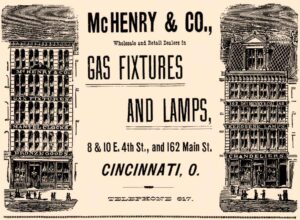
Cincinnati Illustrated Business Directory, 1886, p. 410.
John McHenry was born in Columbia, South Carolina, to Irish immigrant parents and, at eighteen, moved to Baltimore, Maryland, where he saw the country's first gas lights. Rembrandt Peale's art galleries turned them on first in 1816. McHenry arrived in Cincinnati in 1850 and worked at Baker & Von Phul Lamp & Gas Fixtures Co. In 1856, he partnered with Enoch T. Carson to establish McHenry & Carson Co. (162 Main St.). After joining Carson, McHenry invented a burner that produced a “vastly superior light” compared to other public lamps, and by 1857, Cincinnati adopted his burners for city use. He received a patent, which provided brighter light by heating gas in a spiral channel before it reached the flame-spreader wick. In 1869, he led McHenry & Co., selling gas fixtures at two locations (8 E. Fourth & 162 Main Sts.) until the company dissolved in 1893. John McHenry’s business supplied gas fixtures to Music Hall and nearly every major establishment in Cincinnati for almost 40 years.
ANDREW HICKENLOOPER HOLDS A MONOPOLY
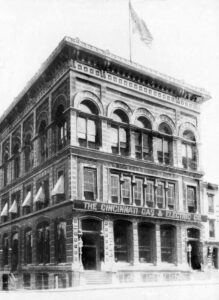
In 1877, Andrew Hickenlooper became the fifth President of the Cincinnati Gas, Light, & Coke Company (today 4th & Plum Apts.). He disliked electricity, which he saw as a threat to his business, calling it “a passing whim.” Hickenlooper was a major supporter of Music Hall, with CGL&C Co. donating $2,000 and a $300 personal subscription for its construction and contributing thousands to Exposition Guarantee Funds. He often attended events in Music Hall, especially Grand Industrial Expositions. At the time, he held a monopoly on the city's gas supply. However, he changed his mind as gas prices and company dividends dropped, when several electrical companies became established in Cincinnati, and electric inventions gained recognition at Expositions held in Music Hall. By 1887, Hickenlooper saw that electric lights were here to stay, so he acquired the Cincinnati Electric Gas Lighting Company and local electric plants, entering the electric business while still providing gas. After consolidating with Cincinnati Edison Electric Co. in 1901, the company became the Cincinnati Gas & Electric Company (today Duke Energy, 139 E. Fourth St.).
1878 – CLEVELAND INTRODUCES ELECTRIC LIGHTS TO CINCINNATI
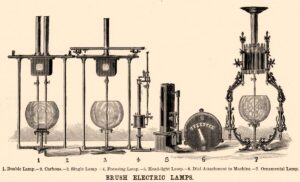
On the closing day of the Third May Festival, May 17, 1878, the Cincinnati Daily Star reported that Shillito’s new department store had calcium lights in its windows. Also called limelight, they were made by heating quicklime (calcium oxide), hence the name, which has nothing to do with the green citrus fruit or the color green. These intensely bright white lights were used in theaters for spotlights and stage lighting, including Music Hall. The same article also announced a fine display of electric lights at the Highland House. It was the “first test of the kind in this city.” The Brush Electric Light Company of Cleveland turned on the lights, powered by its own generators installed in the Mt. Adams Incline power room.
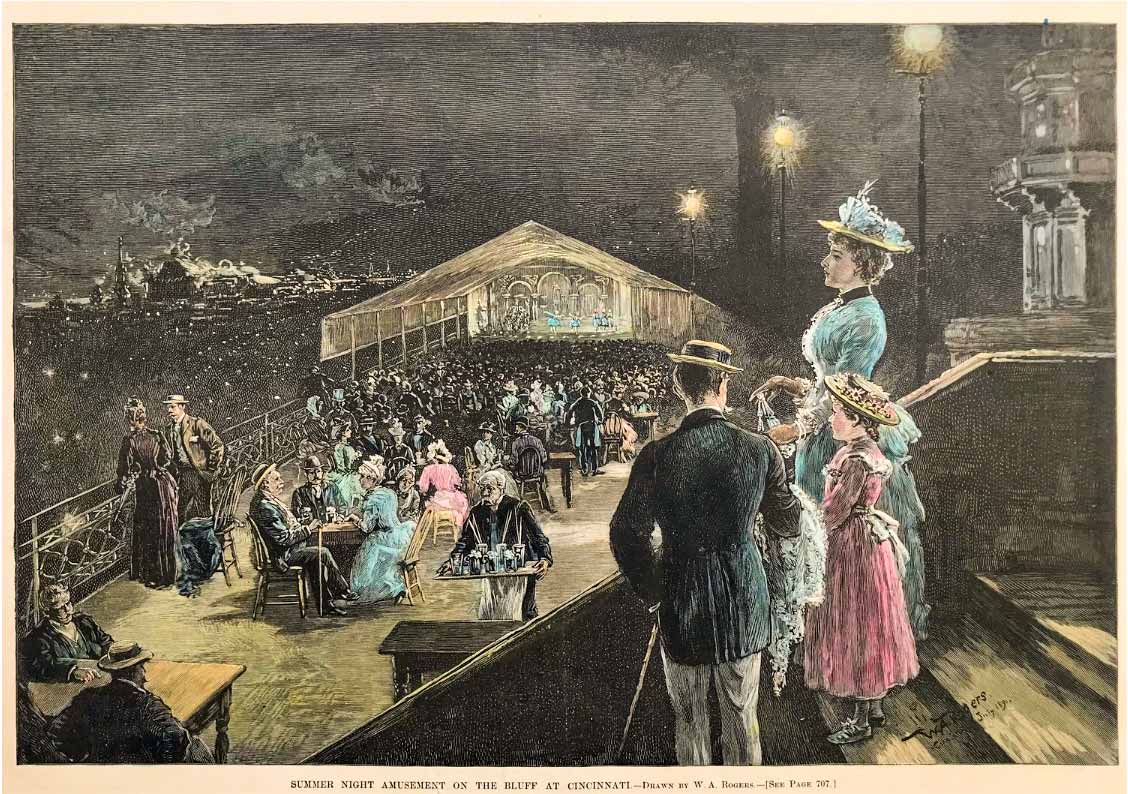
The lights that twinkle and gleam like stars. The city [Cincinnati] itself is bespangled all over with points of electric fire … for miles up and down the valley … countless faint glimmers of light … shines the bluff, with its summer gardens aglow.
Harper’s Weekly, 1890.
Charles Francis Brush developed arc lampposts powered by electricity from a central station. After demonstrating them on Cleveland’s Public Square in April 1879, he was hailed as the innovator of commercial lighting, and Cleveland installed the first public electric streetlamps in the U.S.
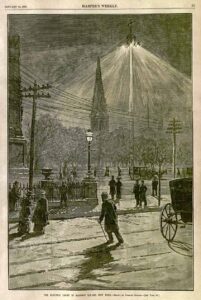
Drawn by Charles Graham, Harper’s Weekly, 1882.
1878 – CITY OF LIGHT – PARIS OF AMERICA
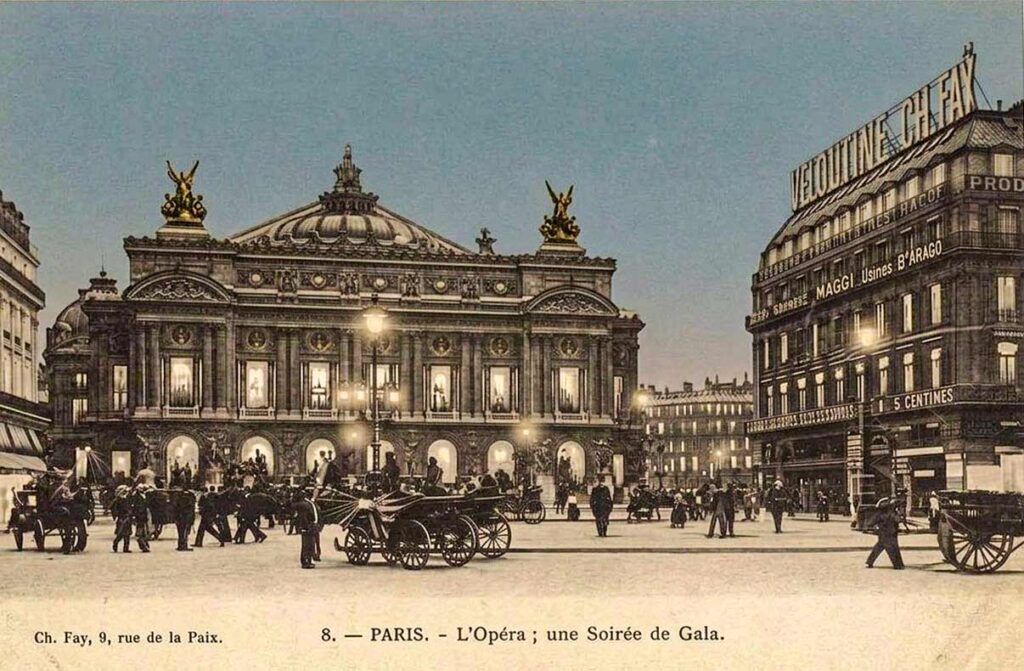
At the 1878 Paris Exposition, the same year Music Hall opened, 64 lampposts topped with ground-glass reflectors cast electric carbon-arc light (Yablochkov candles) onto the Palais Garnier and the Avenue de l'Opéra. Cincinnati, thanks to its burgeoning art scene, had already earned the nickname “Paris of America,” which the opening of Music Hall reinforced. The Enquirer declared, “perhaps this marvelous [Paris lighting] effect could be produced at Cincinnati’s new Music Hall.” Paris, already known as the City of Light partly for its early gas street lighting, had 50,900 streetlamps by the opening of the 1900 Paris Exposition. Meanwhile, in 1879, Thomas Edison perfected an electric incandescent bulb and system to power it, using electric generators called dynamos. Edison's bulbs were better suited for interiors, with a more subdued light than harsh exterior arc lights.
TWO MISERABLE CANDLES IN MUSIC HALL’S ROSE WINDOW
The 1878 and 1879 Cincinnati newspapers glowed about the openings of Music Hall and its wings, respectively. Nearby articles discussed Edison’s electric inventions lighting streetlamps in Menlo Park, N.J., along with complaints that Cincinnati’s streetlamp lighters were not lighting gas lamps on time, and the announcement of the city vote to keep streetlamps lit all night year-round. An 1878 article called for Music Hall’s Rose Window to use calcium lights rather than its “two miserable candles,” and for new experimental electric lights inside the building and on the streets outside.
EIGHT GRAND INDUSTRIAL EXPOS IN MUSIC HALL & ELECTRIC DISPLAYS
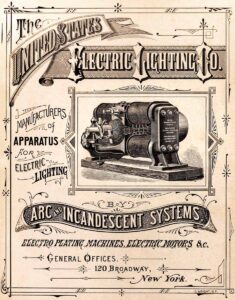
Illustrated Catalog, 1882
In 1879, for the opening of the completed Music Hall for the Seventh Grand Industrial Exposition, the towers were topped with magnificent electric lights, “shedding a concentrated pure white radiance upon objects below,” which “heralds the street lighting of the future.” Temporary electric lights were hung and turned on in the Center Hall and South Hall–Horticultural Hall, but “did not come up to the public’s expectations,” according to the Exposition Commissioners' Report. The electric light machine, or generator, cost a hefty $1,473.50 and was sold at the close of the Expo for $800.
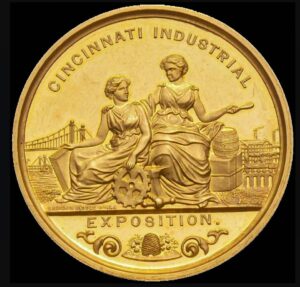
At the 1880 Exposition in Music Hall, Brush Electric Light Company’s lights, among other companies, were on display. In 1879, pioneering African American inventor Lewis Latimer became assistant manager and draftsman for Hiram Maxim's U.S. Electric Lighting Company, and one may speculate he visited the Exposition. He later improved Maxim’s carbon-filament manufacturing process, reducing breakage, before working for Edison Electric Light Company starting in 1884. At the 1881 Expo, Brush displayed the best 15 electric lights, each with 2,000 candlepower, and won a Gold Medal and the $500 premium; the U.S. Electric Lighting Co. of New York also won a Gold Medal, but sued the Commissioners, saying the judges were inexperienced and that they should have won the premium.
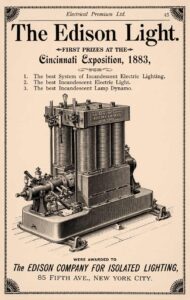
Illus. Premium List, p. 45,
Library of Congress.
1883 – ELECTRIC TESTS AT EXPO & FIRST ELECTRIC LIGHTS IN PALACE HOTEL
At the 1883 Eleventh Industrial Exposition in Music Hall, various electric companies, including The Edison Company and the Cincinnati Electric Gas Lighting Company, showcased incandescent inventions powered by dynamo generators. A room with lights beneath the stage buzzed with “electromotive force,” and a competition measured amperage to determine winners. Also in the 1883 news, C.H. Burdick and J.K. Bigger, dealers in Old Sour Mash Whiskey, Fine Imported Liquors, and Cigars, advertised their saloon in the Palace Hotel (today the Cincinnatian Hotel) as the only venue in town with Edison incandescent lamps, which had “all the yellow softness of gas and all the brilliancy of the ghastly Brush light,” wrote a reviewer in The American Israelite.
1886 – COLORFUL GLOBE GAS LIGHTS ON ARCHES IN FRONT OF MUSIC HALL
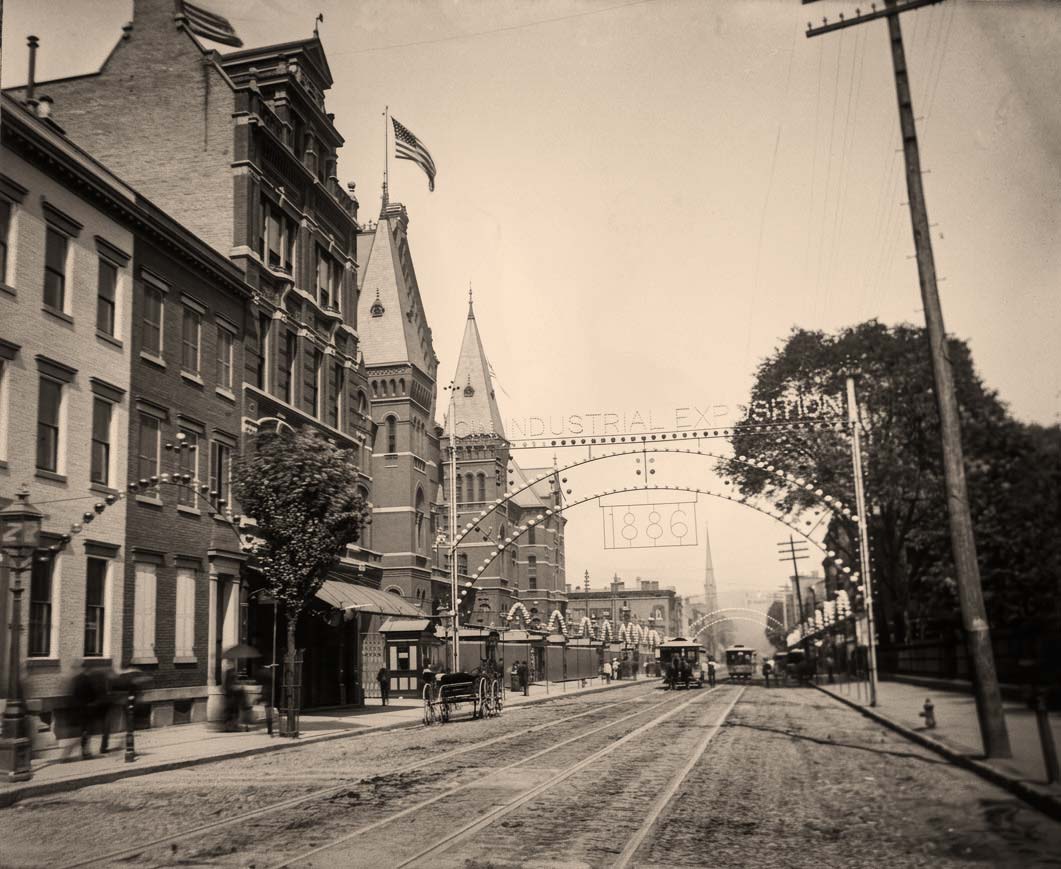
Gas lighting was nearing its pinnacle by the 1886 Thirteenth Grand Industrial Exposition (there was no Expo in 1885). Andrew Hickenlooper and Cincinnati Gas, Light, & Coke Co. created a grand display of incandescent gas lights at Music Hall, both inside and out. On Elm Street, gas pipes reached colored glass globes on arches that spelled out “Cin. Industrial Exposition” and “1886,” as well as arches of lights above Music Hall's main entrances. But electricity stole the show. After visiting the Expo, the Commercial Gazette reviewer exclaimed, “No display excites more interest than the electric light exhibits in Power Hall,” where three companies displayed arc and incandescent lights with Buckeye and Dynamo engines. “You will be convinced,” he wrote, “if you have hitherto doubted that electric lighting is an accomplished fact, and is with us to stay.”
1888 CENTENNIAL EXPOSITION – CINCINNATI’S FIRST BLINK!
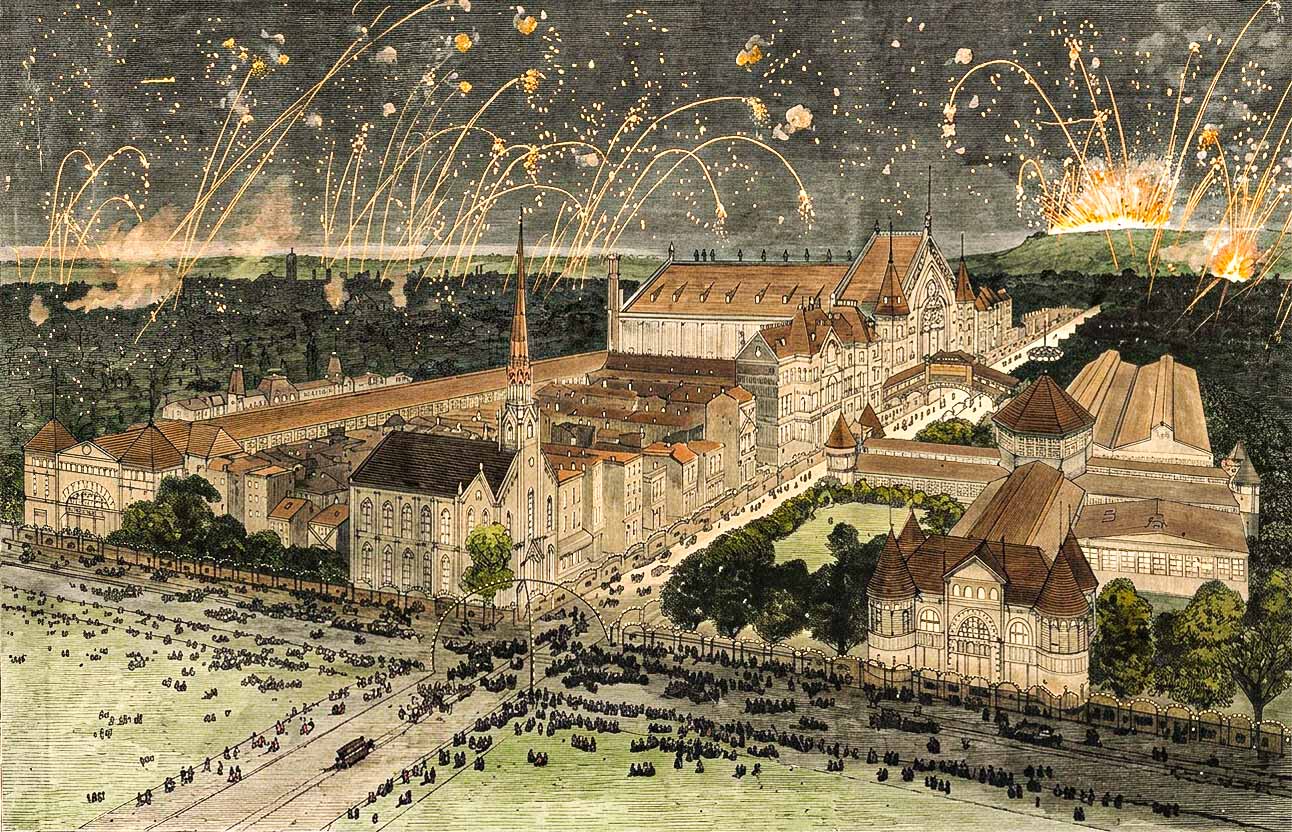
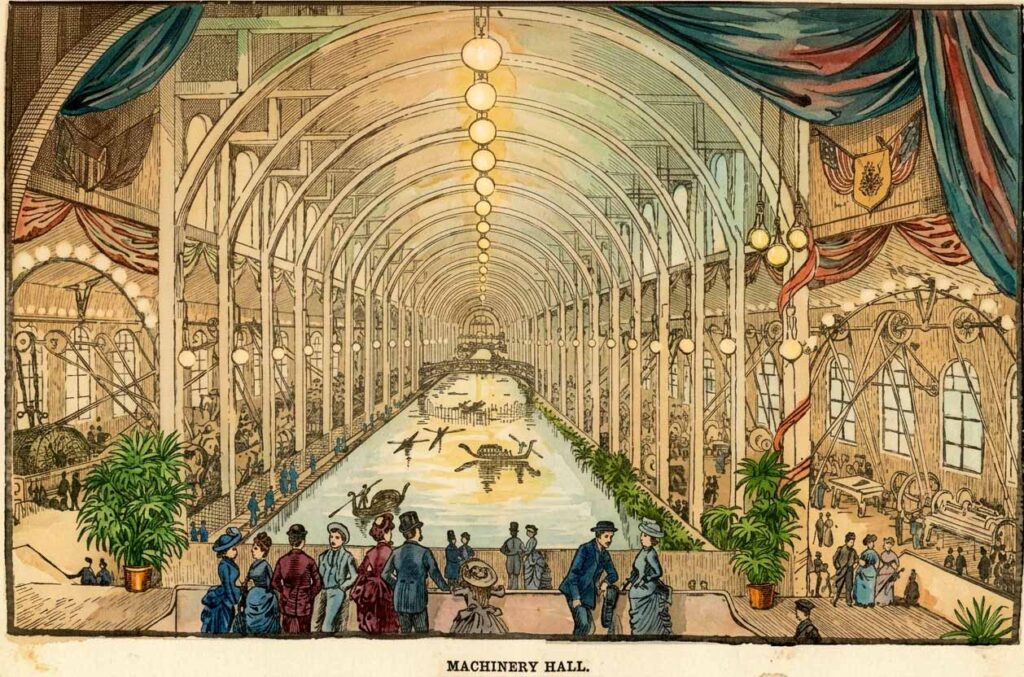
The last Grand Industrial Exposition, or Centennial Exposition of the Ohio Valley and Central States, was held July 4 to November 8, 1888, to celebrate the city’s founding in 1788 within a complex of buildings, including Music Hall, Machinery Hall (1,200 feet long) built over the Miami and Erie Canal, and Park Hall in Washington Park. All the halls were illuminated inside and out with gas and electric lights for “lighting purposes,” as well as spectacular “novel lighting” displays created by electrician William J. Hammer, of the Edison Company, Newark, N.J. The Commissioners’ Report declared it was “the most elaborate piece of electrical engineering of this character ever carried out in this country or Europe.”
1888 CENTENNIAL EXPO – SPECTACULAR COLORED LIGHTS OUTSIDE
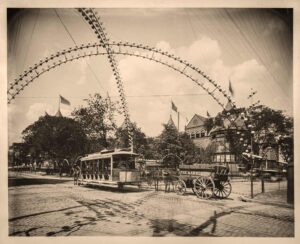
Outside, one hundred arc lamps shone on the buildings and were directed at Music Hall from the top of Park Hall's central pyramidal dome. The streets near Music Hall were lit by over 8,600 colored globes holding 17,000 gas jets. Over the streets leading to the Park Hall entrance on Twelfth Street were canopies of arches sprung from the corners of Plum (Central Pkwy.) and Twelfth, Elm and Twelfth, and Race and Twelfth, with 1,500 gas jets covered with red, white, and blue globes. Long lines of straight arches ran along the streets around the buildings covered with 2,000 colored globes.
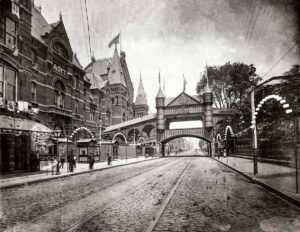
A double arch spanned Elm at Fourteenth, with the upper portion in white globes and the lower in blue globes, topped with “Cincinnati” spelled out in gas jets. The temporary bridge over Elm Street connecting Music Hall to Washington Park, and the park's trees, were lit with 5,000 globes. The Machinery Hall over the canal was lit by colored incandescent lights and had a dedicated power plant in the building. The Centennial Exposition ran for 110 days (closed Sundays), closing on November 8, and a week later, on November 15, a storm blew the arches loose, smashing bulbs. The Gas Company took everything down and threw away all the glass globes.
1888 CENTENNIAL EXPO – ELECTRICITY INSIDE MUSIC HALL
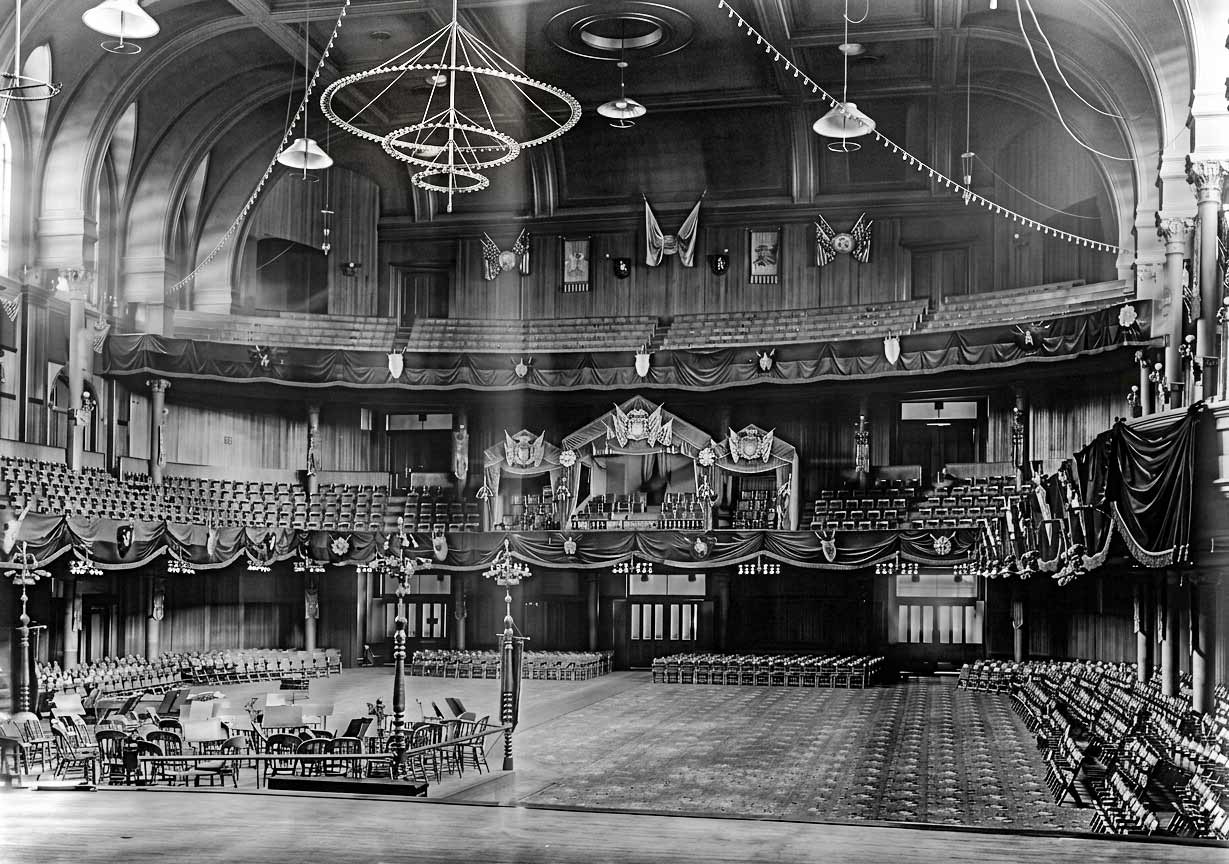
Inside Music Hall, in the main auditorium, hung the “largest electrolier in the world”—an electric chandelier with 200 globes on three iron circles descending in size. Around the balconies, electric lamps in flowered glass shades hung from gas brackets. All the lights could be turned up or down for performances on the main stage. For the Exposition concerts in the auditorium, Michael Brand, conductor of his Cincinnati Grand Orchestra, had a rosewood baton with a 20-candlepower light at the end, a gift of Hammer.
The Art Galleries in Art Hall, at the Elm Street front of Horticultural Hall, had 500 incandescent lamps, and the same number were on the third floor in Dexter Hall (today Corbett Tower). A power room in the North Hall (Pioneer Hall for this Expo) lit the building, as well as the North and South Corridors.
1888 CENTENNIAL EXPO – INSIDE HORTICULTURAL HALL – MAGICALLY LIGHTED
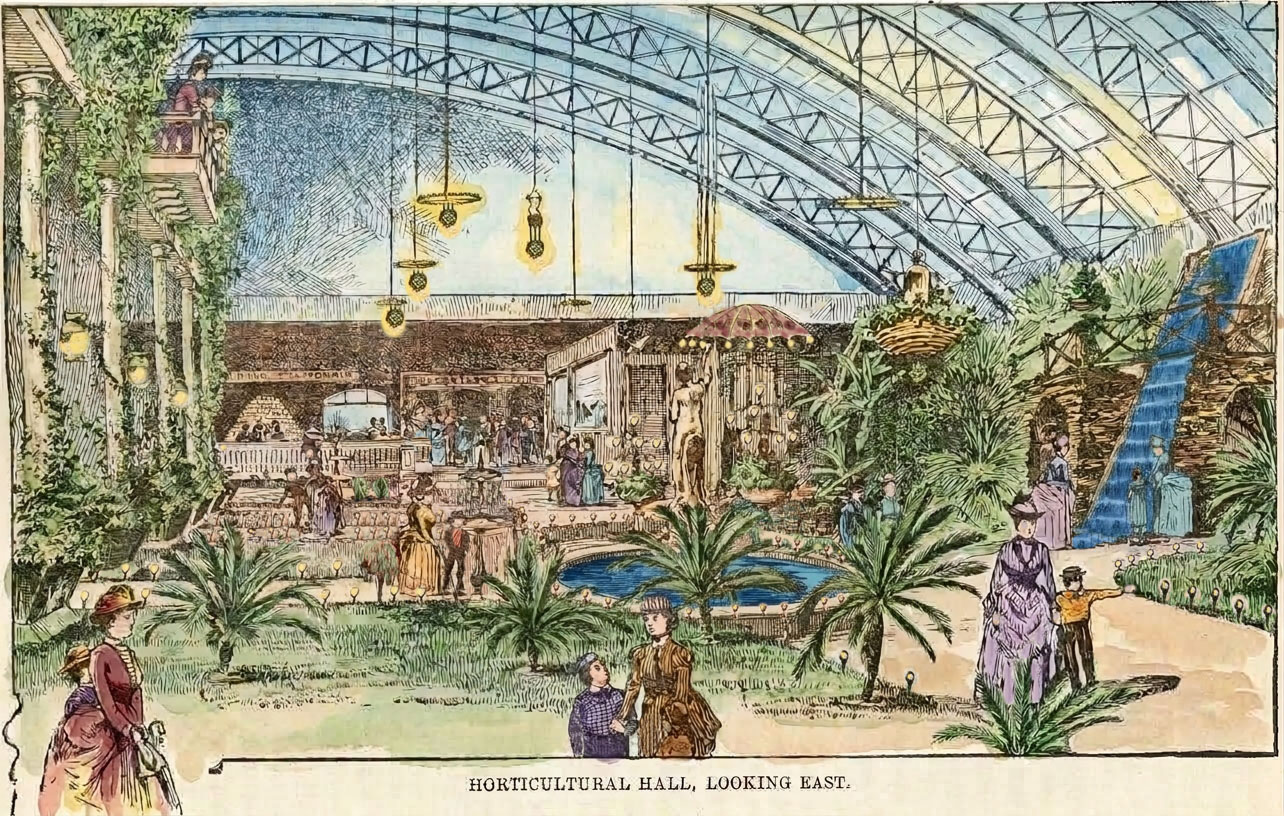
Horticultural Hall, Music Hall’s South Hall, had nearly 1,500 incandescent lamps lighting a tropical garden display. The main feature was a 30-foot-tall waterfall with 100 or more colored electric lights tucked into the rock structure. The room's switchboard was hidden behind the falls, with over 30 miles of wire controlling lights that chased up and down the falls, changed colors, and blinked all over the room. An arched iron form with attached colored lights created a rainbow over the falls, with hues that fluctuated. Above the grotto, crystal balls with colored lights glowed, and decorative owls with lighted eyes perched on the bridges over the basin. Flowerpots held colored lights along lighted paths, and twinkling star-shaped lights were buried in moss, ferns, and ivy. Hanging from the arched glass ceiling was an “electric waterfall” of colored lights, a large, colorfully lit Japanese parasol, and a small ornamental dove flying overhead with a powerful light in its mouth, lighting the room.
1888 CENTENNIAL EXPO – PARK HALL – LIGHT DISPLAYS SPRAY & DAZZLE
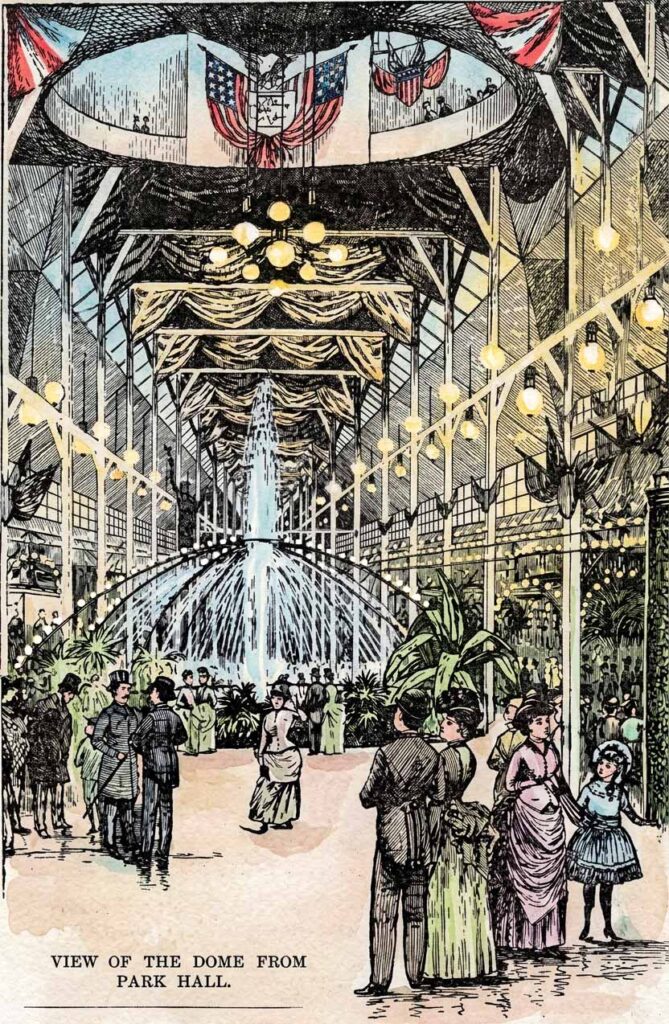
Fountain, p. 14, colorized with Gemini AI.
Park Hall, designed by architect H.E. Siter, and Machinery Hall, designed by James McLaughlin, were built for the Exposition celebrating the city’s 100th year and then torn down; this is known as “Exposition Architecture.” Park Hall was a two-story cruciform shape with a pyramid dome in the center. It covered seven acres of Washington Park, and at the center of the cross, where the four wings met, stood a giant fountain that forced water 60 feet into the air, with 200 smaller water jets and 100 incandescent lights immersed in the cascading water. The main fountain was surrounded by a garden with walking paths, including flowers with 150 electric lights nestled around them. Four electric fountains with Japanese fish swimming inside, each topped with glass umbrellas and clusters of rare colored incandescent lights, stood at each wing. Trees were decorated with owl ornaments featuring blinking eyes, and the ceiling sparkled with illuminated stars and crescents. The north end of Park Hall had a building with glass doors and windows, letting visitors peer inside to see the engines powering the electric lights.
1888 CENTENNIAL EXPO – EDISON ELECTRIC NOVEL LIGHT DISPLAY IN PARK HALL
The north wing of Park Hall featured electric company displays. At the south end of Park Hall, a 31-foot-tall giant lamp featured a 5-foot-diameter globe of wire netting, holding hundreds of little incandescent lights poking through. At the center of the globe were three electric lights of green, blue, and crimson. At the switchboard in Park Hall, breaking the circuits caused lights in globes to change alternately in hue. In front of the giant lamp, a shield read in lights “Exhibit of the Edison Electric Co.”
1895 MUSIC HALL GETS PERMANENT ELECTRICITY
By 1881, Palais Garnier in Paris began installing electric lighting inside, but Music Hall would not have interior permanent electric lights until its 1895 renovation by Hannaford and Sons. The 1896 Annual Report of the Music Hall Association stated, “a complete system of electric light wiring, together with new gas and electric light fixtures, has been installed. The stage and ceiling lights of the hall (Springer Auditorium) are electric only, while other fixtures are made in combination, for both gas and electric light.”
1900–1923 – SIX FALL FESTIVALS ILLUMINATE THE CITY
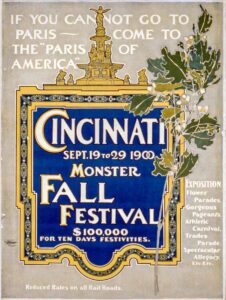
As Grand Industrial Expositions fell out of fashion by the end of the century, six Fall Festivals blossomed between 1900 and 1923. Buildings along the banks of the Miami and Erie Canal and in Washington Park, as well as Music Hall, hosted daylong and evening entertainment, creating a carnival-like atmosphere.
The Festivals began with parades of lighted floats, and buildings across town were decorated with colorful lights in celebration, from City Hall to the Chamber of Commerce, the Public Library to small businesses. “The electrical illumination of a myriad of lights in Washington Park, the Exposition buildings, the front of Music Hall, and the canal bank were scenes of unusual brilliancy,” reported the Enquirer.
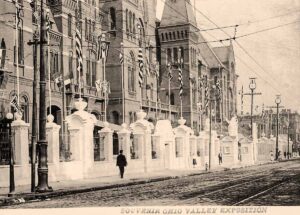
The First Fall Festival in 1900 included strands of lights strung across streets and over the canal, and great streamers of lights were suspended from Music Hall's metal pinnacles on the roof, spreading out as they fell in varied colors in a dazzling effect. In 1901, the Second Fall Festival featured a large electric fountain in Washington Park. During the Third Fall Festival in 1902, two electric wires crossing in Machinery Hall sparked a blaze that mounted officers quickly extinguished. For the 1903 Fourth Fall Festival, the fire company and expert electricians were on hand at all times to supervise the 30,000 incandescent lights for displays and 500 lamps lit the grounds. The highlight of the Festival was the Marco Polo Spectacle on a mammoth stage built at the back of Music Hall facing the canal, which opened nightly at 8:30 p.m. with a lighted float parade.
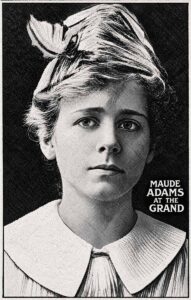
The committee for the 1906 Fifth Fall Festival tried unsuccessfully to secure the famous actress and stage-light innovator, Maude Adams. She did appear at Cincinnati’s Grand Theater a few months later. However, ladies were definitely wearing the fashionable Peter Pan hat she inspired at the Festival.
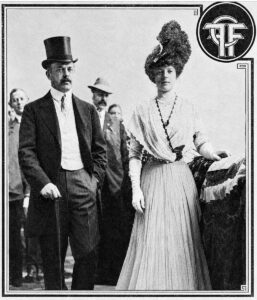
The celebrity appearance at the 1906 Festival was Alice Roosevelt Longworth, the U.S. President’s daughter, with her Cincinnati husband, Congressman Nicholas Longworth III. Alice, waving to the crowd in Washington Park with Nick beside her on Music Hall’s flower-bedecked balcony, captured the limelight when she pressed a golden electric button to formally open the grounds with a “myriad of lights dazzling in Washington Park and Music Hall.”
1923 – TOWER OF JEWELS IN WASHINGTON PARK CREATES A FAIRYLAND
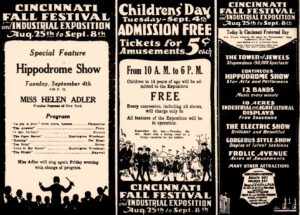
At the 1923 Sixth Fall Festival, the entrance to Music Hall was transformed by 20 gigantic white pillars topped with eagles and 48 high-power electric lights that sent beacon signals across the city. At Race Street, a Great Arch, 80 feet wide by 40 feet high, was lit with twinkling lights of all colors. The Cincinnati Electric Club staged the South Hall as an Electrical Palace. Several thousand brightly hued lights decorated the hall, and exhibits included all practical uses of electricity; demonstrations included telephone calls made across the room to auto-player pianos of the Krell Piano Company, playing ragtime.
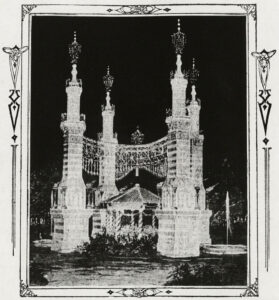
But the most spectacular feature was the $50,000 Tower of Jewels in Washington Park with 5,000 miniature electric lights mounted on 20 sunburst standards. The center was festooned with jeweled glass, connected to the corner tower spires and minarets by strands of gems, which held pendant clusters of crystals in all colors of the rainbow. At 8:15 p.m. on August 25, 1923, the Chair of the Washington Park Lighting Committee turned to the President of the Festival and ordered the towers to be lit. He pressed a button, and newspapers reported it sounded like a bomb exploding overhead; as the echo resounded off the walls of Music Hall, the tower burst forth in a scintillating blaze of light. Searchlights with 7,500-candlepower were pointed at the tower, reflecting the jewels' colors into the trees and bushes in the park, making it look as if fairies were dancing around. At a signal, the searchlights changed color, and an aura of blended colors, a spontaneous aurora borealis, transformed into a new display. The spectacle was visible from the hilltops and into Kentucky.
1929 – EDISON EXPOSITION – LIGHTS TURNED ON FROM WOOSTER & AN AIRPLANE
In 1929, the Cincinnati Edison Exposition, held under the auspices of the Cincinnati Electric Club, celebrated the fiftieth anniversary of Edison’s incandescent lamp in Music Hall. Exhibits illustrated the development of electric lights and power. Governor Myers Y. Cooper turned on the lights throughout the three wings of Music Hall with the press of a button in Wooster, Ohio, connected by a 200-mile wire. Floodlights lit the front and back exteriors of Music Hall, with 127 lights alone on Central Parkway, marking the largest assembly of such lights ever used locally. William E. Stilwell, Jr., inventor of an electric radio control system for activating airport lights from an airplane, flew overhead and used the system to switch on Music Hall's exterior lights from the air.
2013–2026 – LUMENOCITY TO BLINK TO TODAY’S NEW EXTERIOR LIGHTS BY FMH
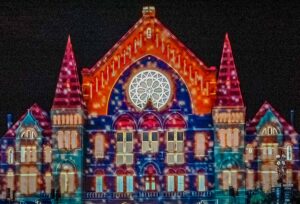
Music Hall, Aug. 4, 2013.
In 2013 and 2014, Lumenocity used 3D projection mapping to create a unique light performance, never experienced in Cincinnati before, on the front façade of Music Hall, accompanied by the Cincinnati Symphony Orchestra and Cincinnati Pops Orchestra, drawing over 40,000 attendees each year.
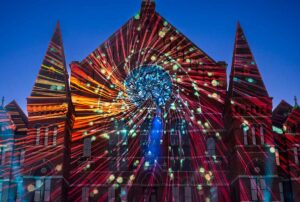
Music Hall, Oct. 7, 2024.
Lumenocity's success at Music Hall inspired the city’s first Blink festival in 2017, showcasing light installations across downtown Cincinnati, including projection mapping on the Music Hall façade in 2024 and 2026.
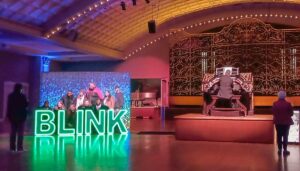
The Friends of Music Hall funded Blink in the Ballroom in 2022 and 2024, a free, public event during Blink week. Returning in 2026, the Music Hall Ballroom becomes an immersive space with dynamic lighting, a Blink photo wall, and classic songs by a guest organist on the FMH Wurlitzer Organ.
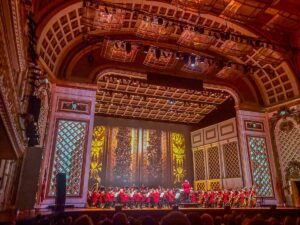
Hook & Hastings Organ Panels.
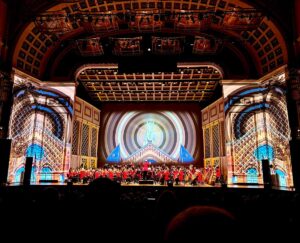
Sept. 9, 2026, Angel of Music statue.
2026 NEW EXTERIOR LIGHTING FUNDED BY FRIENDS OF MUSIC HALL
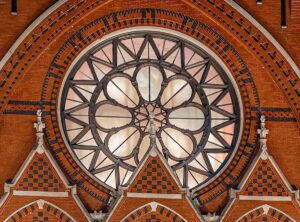
New exterior lighting is coming soon to Music Hall! No new exterior floodlighting has been installed on Music Hall since 1985, when fundraising by Jean Reis and Joyce Van Wye through the Society for the Preservation of Music Hall (SPMH), major funding from Louise and Louis Nippert, and a grant from Rhoda and Manuel D. Mayerson installed exterior floodlights, “Hannaford-inspired” lampposts on the plaza steps, and lighting behind the Rose Window. SPMH, today Friends of Music Hall (FMH), funded new lighting behind the Rose Window in 2000, with Cincinnati Opera lighting designer Jay Depenbrock and architect Ken Jones donating their talents.
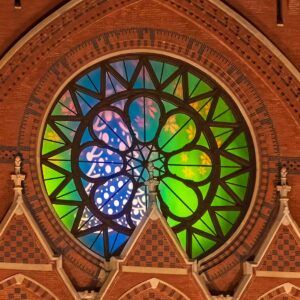
In 2022, FMH funded new colorful lighting in the Rose Window, which is ever-changing today. Gary Kidney, Music Hall’s Technical Director, designed and installed the Rose Window’s LED strip lights, Leko shutter stage lights, and changeable gobo templates, so that ghosts can fly in the attic at Halloween and more. The Cincinnati Arts Association (CAA) controls and schedules the colors, coordinating them with event themes in the building and with the resident companies. The 2016–2017 rehabilitation of Music Hall included rewiring the auditorium chandelier, which now has LEDs, and FMH funded the same for the three chandeliers in Corbett Tower; it also ran conduit for future exterior lights but left wiring and fixtures for future donors—until now.
In 2023, FMH picked up the torch, hiring KLH Engineers to design state-of-the-art LED lighting to illuminate architect Samuel Hannaford's architectural details top to bottom on the entire front (east) façade and the central apse on the back (west) façade. FMH's Capital Projects Committee — Ed Rider and Thea Tjepkema, Co-Chairs, Andreas Lange, Glenn Plott, and Ken Jones — has worked with KLH's Senior Lighting Designer, Matt Minard (a guest speaker at FMH's 2025 Annual Meeting), to shed light on Music Hall's architecture, especially the FMH-restored gable finials, with warmer, more even light overall.
Guided by preservation principles, the team kept the plan grounded in National Park Service lighting standards to protect the historic character and materials of this National Historic Landmark. The result: in-ground lights for the front façade, supplemented by fixtures on the existing street poles and on the front center balcony floor. On the back, the center apse will be lit for the first time, its north and south sides by balcony-floor fixtures and its center by fixtures carefully installed in the brick mortar above the sandstone banding.
In September 2025, GBBN Architects and HGC Construction came aboard to run the project, coordinating with CAA engineer Jeff Enderle, who helped track down the 2016–2017 conduit and scouted hidden paths for wiring to be kept out of sight, which is no small feat in a building with nearly 150 years of renovations. Look closely at the main entrances, and you will spot yellow plastic disks spaced evenly in the plaza's concrete pavement at the north and south halls, and in the red granite tiles on the stair landings at the central hall—placeholders for the new lights arriving soon.
The new Lumenpulse lights are LEDs that can create light from very soft white to daylight brilliance; they are high-performance and environmentally responsible, operate with low energy consumption and high efficiency, and are individually programmable with a Pharos Cloud remote control system that CAA can control with the push of a button.
Excitement is building for the exterior light unveiling, when Hannaford's brilliant High Victorian Gothic details will finally dazzle at night in a soft, even wash of warm yellow-white light, echoing the golden glow of the gas streetlamps that lit Music Hall when it opened in 1878.